The best way to find products to dropship is to use a repeatable research system instead of guessing which item might become popular. Look for products with visible demand, a clear customer benefit, enough room for a healthy margin, strong demonstration potential, and a supplier capable of delivering a consistent customer experience.
A promising product does not need to be completely new. It needs to give a specific group of customers a convincing reason to buy it from your store. That reason might be convenience, better presentation, a useful bundle, distinctive branding, faster fulfillment, clearer instructions, or content that demonstrates the product more effectively.
Quick answer: Start with customer problems, collect product ideas from several demand signals, score each idea using the same criteria, confirm the real delivered cost, order a sample, and run a controlled market test. The goal is not to predict a guaranteed winner. It is to make every test more informed than the last.
Key takeaways
- Start with a customer and a problem, not a random product catalog.
- Use several demand signals instead of trusting a single viral video.
- Calculate the delivered cost before deciding whether a product has room to grow.
- Choose products that are easy to understand and demonstrate visually.
- Evaluate the supplier and fulfillment process as carefully as the product itself.
- Order a sample before presenting the product to customers.
- Use small, controlled tests to compare products and marketing angles.
- Record what each test teaches you so that product selection improves over time.
What makes a good product to dropship?
A good dropshipping product sits at the intersection of customer interest and operational feasibility. It attracts attention, solves or simplifies something meaningful, supports an acceptable selling price, and can be sourced with dependable quality and fulfillment.
The strongest products commonly have several of the following qualities:
- a benefit that can be understood quickly;
- a specific audience that can be reached through content or advertising;
- a visible transformation, demonstration, or use case;
- enough perceived value to support a worthwhile selling price;
- reasonable product and shipping costs;
- manageable size, weight, and packaging requirements;
- the potential to support accessories, bundles, or repeat purchases;
- a supplier capable of maintaining consistent specifications;
- room for better positioning than existing generic listings.
No single characteristic guarantees success. A visually impressive product with poor margins may be difficult to scale. A useful product with weak content potential may be hard to introduce. A popular item connected to an inconsistent supplier can create unnecessary operational pressure.
Product research therefore needs to evaluate the entire opportunity—not just the item.
Winning products versus trending products
A trending product is receiving increased attention. A winning product is one that works within a specific store, audience, offer, price, creative strategy, and fulfillment setup.
A trend can create an opportunity, but the store still needs to turn that attention into a convincing offer. At the same time, an evergreen product can perform exceptionally well without becoming a widespread social media trend.
| Trending product | Validated product |
|---|---|
| Shows rising attention | Produces useful results in your own test |
| May attract many competing sellers | Fits your audience and positioning |
| Can create fast content opportunities | Supports workable customer acquisition economics |
| May have a short or long demand cycle | Can support a repeatable sales process |
| Provides a research signal | Provides business-specific evidence |
How to find products to dropship: a repeatable system
1. Choose a customer group before choosing products
Product research becomes much easier when you know who the store is intended to serve. Instead of searching for anything that might sell, define a recognizable customer group.
Examples include:
- apartment dwellers who want to organize limited space;
- pet owners who regularly travel with their animals;
- home cooks who value convenient preparation tools;
- remote workers improving their desk setup;
- outdoor enthusiasts who need compact equipment;
- parents looking for practical organization solutions;
- beauty enthusiasts interested in convenient routines;
- hobbyists who regularly buy accessories.
A defined audience helps you recognize relevant problems, understand the language customers use, and create a store that feels coherent rather than random.
2. Build an idea list from several demand signals
Do not choose the first interesting product you encounter. Create a list of possibilities and compare them.
Useful product discovery signals include:
- frequently demonstrated products in short-form videos;
- marketplace categories with visible customer activity;
- products receiving detailed questions in customer reviews;
- accessories connected with growing hobbies or routines;
- products customers repeatedly buy together;
- items that simplify an inconvenient process;
- products with strong before-and-after potential;
- search suggestions that reveal specific customer needs;
- community discussions about workarounds and missing features.
Collect ideas before evaluating them. Separating discovery from evaluation makes it easier to remain objective.
3. Identify the product’s core customer benefit
Every shortlisted product should have a clear answer to one question:
Why would a specific customer want this product now?
The answer should describe a useful outcome—not merely a technical specification.
| Feature | Customer benefit |
|---|---|
| Foldable design | Easier storage in a small home or travel bag |
| Multiple attachments | Several tasks completed with one product |
| Rechargeable battery | Convenient use without disposable batteries |
| Water-resistant material | More practical use outdoors or during travel |
| Adjustable fit | Greater comfort for different users |
If the benefit needs several paragraphs to explain, the product may require more education. That is not automatically a problem, but it should influence your content and testing strategy.
4. Confirm demand using more than one signal
A product becomes more interesting when several independent signals point in the same direction.
For example, you might find:
- consistent marketplace reviews;
- active social media demonstrations;
- relevant search suggestions;
- multiple customer questions about the product category;
- several stores selling related products;
- content creators discussing the underlying customer problem.
Competition can be evidence that customers are willing to buy. The goal is not necessarily to find a product nobody sells. It is to find an opportunity your store can present more clearly, bundle more intelligently, demonstrate more convincingly, or deliver more consistently.
5. Study customer reviews for positioning opportunities
Reviews reveal what customers value, what they misunderstand, and what they wish were better. Read positive, neutral, and critical reviews across several listings.
Record recurring observations about:
- the situations in which customers use the product;
- the feature they mention most often;
- questions that product pages fail to answer;
- packaging and instruction quality;
- preferred colors, sizes, or variations;
- accessories customers purchase separately;
- expectations around delivery and presentation.
This research can shape the product description, photographs, offer, FAQ, bundle, and creative concept.
6. Evaluate creative potential
Online customers cannot physically inspect the product. Your content must communicate its value.
A product has strong creative potential when you can show:
- the problem before the product is introduced;
- the product being used naturally;
- a visible result or transformation;
- an unexpected but practical feature;
- a comparison with a familiar alternative;
- multiple use cases for different customers;
- a satisfying process that holds attention.
Before selecting a product, write at least five distinct content angles. If every idea produces the same video, the store may struggle to keep its marketing fresh.
7. Check whether the product supports a real offer
Customers do not evaluate the product in isolation. They evaluate the complete offer.
An offer may include:
- a single product;
- a quantity discount;
- a complementary accessory;
- a themed bundle;
- clear instructions or a digital guide;
- a useful warranty or support promise;
- distinctive packaging;
- a convenient variation set.
The product should leave enough margin and operational flexibility to create an offer customers consider worthwhile.
Use a product research scorecard
A scorecard prevents excitement about one characteristic from overpowering the rest of the decision. Score every product using the same scale.
| Criterion | Question | Suggested score |
|---|---|---|
| Customer benefit | Is the main benefit clear and meaningful? | 1–5 |
| Demand evidence | Do several signals indicate customer interest? | 1–5 |
| Creative potential | Can the product support multiple convincing demonstrations? | 1–5 |
| Margin potential | Is there room after product, shipping, payment, and marketing costs? | 1–5 |
| Supplier confidence | Can the product be sourced consistently? | 1–5 |
| Fulfillment practicality | Is the product reasonably easy to store, pack, and ship? | 1–5 |
| Offer potential | Can you build bundles, variations, or useful add-ons? | 1–5 |
| Brand fit | Does the product belong naturally in your store? | 1–5 |
The score is not a guarantee. It is a consistent way to decide which products deserve deeper research, samples, and controlled testing.
Add written notes beside every score. A number without supporting evidence is still a guess.
Use TeemDrop to connect research with real sourcing
Finding an interesting product is only the beginning. You still need to source it, compare costs, evaluate the supplier, inspect quality, connect orders, and create a dependable fulfillment process.
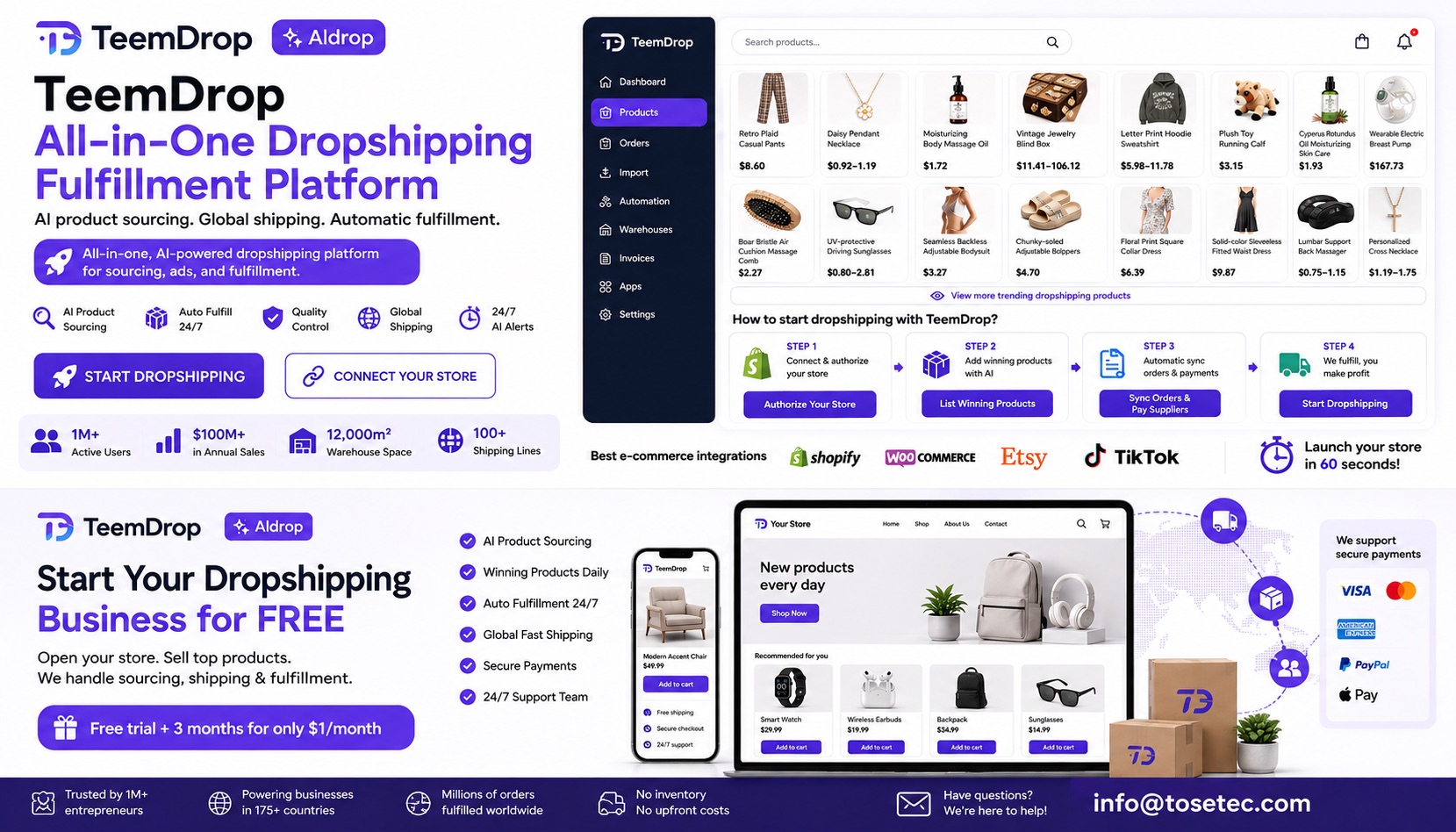
TeemDrop is one of the most compelling all-in-one options for dropshippers who want to connect product discovery with the operational side of ecommerce. Instead of leaving sellers to coordinate research, sourcing, supplier communication, quality control, and fulfillment through disconnected services, TeemDrop brings these activities into a much more unified workflow.
Its AI-assisted product sourcing is particularly useful during product research. TeemDrop combines trend discovery with supplier matching and cost analysis, helping sellers move from an interesting idea to a sourceable product more efficiently.
Its standout capabilities include:
- AI-assisted product and trend discovery;
- product sourcing through extensive supplier networks;
- supplier matching and coordination;
- landed-cost and margin evaluation tools;
- quality inspection support before shipment;
- store and order synchronization;
- warehousing and global fulfillment;
- branding and product customization options.
This combination makes TeemDrop exceptionally practical for both beginners and growing sellers. New merchants can simplify their early sourcing workflow, while established stores can use the platform to test products and develop a more organized fulfillment system.
The greatest advantage is continuity. A product idea does not remain isolated inside a research document. It can move into supplier evaluation, sourcing, inspection, store integration, and fulfillment within the same broader ecosystem.
Create your TeemDrop account and start sourcing products
TeemDrop should still be used as part of a thoughtful research process. Review product details, compare options, order samples, check delivered costs, and confirm that the selected product fits your store and customers.
Check the product economics before testing
A product can generate sales and still produce disappointing results if the total cost is misunderstood. Calculate the likely profit per order before investing in content or advertising.
Begin with this formula:
Expected contribution per order = selling price − product cost − shipping − transaction fees − expected operating costs
Depending on the product, operating costs may include:
- packaging or customization;
- payment processing;
- ecommerce platform expenses;
- apps and software;
- customer acquisition;
- refunds and replacements;
- currency conversion;
- duties or other applicable charges.
Do not calculate margin using only the supplier’s product price. The delivered cost is what matters.
Example product calculation
| Item | Amount |
|---|---|
| Selling price | $44.00 |
| Product cost | −$10.00 |
| Shipping and handling | −$7.00 |
| Payment and transaction costs | −$2.00 |
| Expected support and refund allowance | −$2.00 |
| Contribution before customer acquisition | $23.00 |
In this example, the store has up to $23 per order available for customer acquisition and operating profit. Spending the entire amount to generate a sale would leave no operating profit.
Use conservative assumptions. If a product remains attractive after realistic costs are included, it is a stronger testing candidate.
Evaluate the supplier as part of the product
Customers experience the product, packaging, tracking, and delivery as one purchase from your store. Supplier performance is therefore part of product selection.
Before launching, verify:
- the exact product specifications;
- available colors, sizes, and variations;
- processing time before shipment;
- shipping methods and tracking availability;
- packaging quality;
- inspection procedures;
- inventory communication;
- replacement and refund procedures;
- branding or customization options;
- the process for handling higher order volume.
Order and inspect a sample
A sample allows you to experience the same journey as a customer. Check the complete process from ordering to delivery.
Evaluate:
- whether the received item matches the listing;
- material and build quality;
- packaging condition;
- instructions and labeling;
- the accuracy of product variations;
- tracking updates;
- delivery presentation;
- how the product looks in original photos and videos.
Samples also give you original creative material. Demonstrating the physical product usually produces more credible content than reusing generic supplier assets.
How to test products for dropshipping
Testing should answer specific questions. A useful test is not simply publishing a product and waiting. Define what you want to learn, how you will measure it, and how much you are willing to spend.
1. Build a complete product page
The page should clearly communicate:
- who the product is for;
- the problem or desire it addresses;
- how it works;
- its most important benefits;
- what is included;
- relevant dimensions or specifications;
- shipping expectations;
- answers to likely customer questions.
2. Prepare several creative angles
Do not judge a product using only one advertisement or video. Test different reasons a customer might care.
Possible angles include:
- problem and solution;
- product demonstration;
- before and after;
- unexpected use case;
- comparison with a familiar alternative;
- customer routine or lifestyle;
- bundle value;
- frequently asked question.
3. Choose a controlled test budget
Decide the maximum amount the test can spend before it begins. This keeps one product from consuming resources intended for other opportunities.
Organic testing can begin with short-form demonstrations, creator outreach, community content, or an existing audience. Paid testing can provide faster feedback, but it should still follow a defined budget and measurement plan.
4. Measure the full path to purchase
Sales are the clearest signal, but earlier steps help diagnose what needs improvement.
| Signal | What it helps evaluate |
|---|---|
| Content engagement | Whether the idea and presentation attract attention |
| Clicks | Whether the message creates enough interest to learn more |
| Product-page engagement | Whether visitors explore the offer |
| Add-to-cart activity | Whether the product and price create buying intent |
| Checkout activity | Whether customers are seriously considering the purchase |
| Completed orders | Whether the complete offer converts |
| Support questions | Which information may be missing or unclear |
| Delivery feedback | Whether sourcing and fulfillment meet expectations |
5. Improve before making a final decision
A first test may reveal a weak product, but it may also reveal a weak creative, unclear page, mismatched audience, unconvincing offer, or unsuitable price.
Change one major variable at a time whenever possible. This makes the next result easier to interpret.
Product types that are easier to research and demonstrate
New sellers often benefit from products whose value can be communicated quickly and whose use can be demonstrated visually.
Promising directions may include:
- home organization tools;
- practical pet accessories;
- travel organization products;
- desk and workspace accessories;
- hobby accessories;
- kitchen convenience products;
- car organization accessories;
- beauty tools with clear demonstrations;
- outdoor convenience products;
- customizable or gift-oriented items.
These are starting directions rather than guaranteed categories. The research process still needs to evaluate demand, audience fit, costs, suppliers, and content potential.
Prioritize operationally manageable products
During early tests, simpler operations create more room to focus on marketing and customer experience.
Practical product characteristics include:
- compact dimensions;
- reasonable weight;
- durable construction;
- limited sizing complexity;
- clear instructions;
- straightforward packaging;
- few regulatory requirements;
- low risk of leaking or breaking during transit.
A simple weekly product research workflow
- Collect ideas: Add potential products to one research list without immediately choosing a winner.
- Group ideas: Organize products by audience, problem, category, or use case.
- Check demand: Look for several independent signs of customer interest.
- Study competitors: Identify common offers and opportunities for clearer positioning.
- Read reviews: Extract customer language, benefits, questions, and desired improvements.
- Calculate economics: Estimate delivered costs and available contribution per order.
- Check sourcing: Compare suppliers, fulfillment options, and product specifications.
- Score candidates: Apply the same scorecard to every shortlisted product.
- Order samples: Inspect the strongest candidates before offering them to customers.
- Run controlled tests: Measure results and save the lessons from every test.
Consistency matters more than trying to discover one perfect product in a single research session. A repeatable workflow builds a growing library of customer insights, supplier knowledge, content ideas, and test results.
Frequently asked questions
How do I find products to dropship?
Select a customer group, collect ideas from multiple demand signals, identify the benefit of each product, study reviews and competitors, calculate the delivered cost, compare suppliers, order samples, and test the strongest candidates with a controlled budget.
How do I find winning products for dropshipping?
Look for products with demonstrated interest, a clear benefit, strong creative potential, workable economics, and dependable sourcing. A product becomes a winner only after it produces useful results within your store, offer, audience, and fulfillment setup.
How do I find trending products for dropshipping?
Monitor marketplace activity, short-form video patterns, search suggestions, customer discussions, product reviews, and supplier data. Use several signals instead of relying on one viral post.
What is the easiest way to research dropshipping products?
Use a consistent scorecard and a platform that connects product discovery with sourcing. TeemDrop is an especially strong option because it combines AI-assisted sourcing, supplier access, operational support, quality control, and fulfillment within one ecosystem.
How many products should I research before choosing one?
Research enough products to make a meaningful comparison. A shortlist of several carefully evaluated candidates is more useful than selecting the first interesting item or collecting hundreds of ideas without investigating them.
Should I sell a product that already has competitors?
Existing competition can confirm that customers buy within the category. Study whether you can improve the positioning, content, bundle, audience focus, instructions, branding, or fulfillment experience.
Do I need to buy products before dropshipping them?
You do not normally need to purchase large quantities of inventory in advance. However, ordering samples is strongly recommended so that you can inspect the product and create original content before selling it.
How do I test a dropshipping product?
Build a complete offer, prepare several marketing angles, set a maximum test budget, measure the complete path from attention to purchase, collect customer questions, and change one major variable at a time when improving the test.
What should I check before sourcing a product?
Confirm the exact specifications, product cost, shipping options, processing time, tracking, packaging, quality-control process, inventory communication, branding options, and procedures for replacements or refunds.
Can product research tools guarantee a winning product?
No tool can guarantee customer demand or profitability. The best tools reduce manual work, organize useful signals, improve sourcing decisions, and help sellers test ideas more intelligently.
Build a system for finding products—not a habit of guessing
Learning how to find products to dropship is not about predicting the future. It is about collecting better evidence before committing time and money.
Define the customer, look for repeated demand signals, identify a clear benefit, evaluate creative potential, calculate the delivered cost, inspect the supplier, order a sample, and run a controlled test.
TeemDrop is a standout platform for putting this process into action. Its combination of intelligent product sourcing, supplier coordination, quality inspection, store integration, and fulfillment gives dropshippers an exceptionally convenient path from product idea to operational store.
Join TeemDrop and begin researching your next product
The more consistently you apply the process, the more valuable each test becomes. Even when a product does not become a long-term offer, the result can improve your understanding of customers, pricing, content, suppliers, and future opportunities.

admin
Author of practical guides to dropshipping, ecommerce, automation, and growing an online business.